10 ROAS Optimization Tips to Maximize Ad Spend
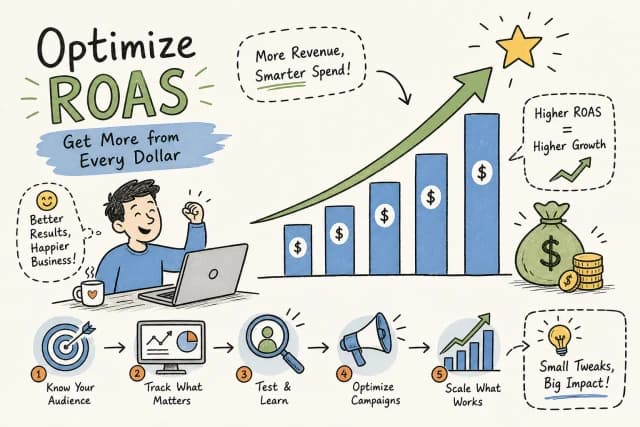
These 10 ROAS optimisation tips address the most common and fixable causes of poor ad performance on Google and Meta, grouped into five practical phases: setting the right targets, fixing your data, correcting your bid strategy, sharpening your audience, and removing creative and funnel friction. Most ROAS problems are not bid strategy problems. They are measurement, audience, or creative problems that bidding algorithms cannot solve on their own.
At ThinqMedia, we manage paid media campaigns across Google and Meta for clients in e-commerce, fintech, real estate, and SaaS. In our experience across a broad portfolio of accounts, the same ROAS leaks appear repeatedly. These strategies address the ones that move the needle fastest, applicable across a wide range of monthly budgets, from smaller spends to campaigns running at ₦5 million and above.
Key takeaways
Margins before metrics: Standard ROAS hides whether you are actually profitable. Always calculate margin-adjusted ROAS before making any bid decision.
Fix tracking first: Duplicate conversion events and misaligned attribution windows corrupt your data and cause bidding algorithms to optimise against false signals.
Data volume drives bidding: Value-based bid strategies only work reliably when campaigns have enough conversion signal. Consolidate before you constrain.
First-party data is your edge: Your customer purchase list is your most powerful targeting asset for lookalikes and exclusions across both platforms.
Creative angle beats creative polish: The biggest short-term ROAS gains come from changing the offer or hook, not swapping images or adjusting button colour.
Daily optimisation compounds: A weekly review cycle allows ROAS leaks to run unchecked for days. Faster monitoring reduces time-to-detect and time-to-fix issues compared with weekly reviews.
Set a ROAS target that actually reflects your margins
Tip 1: Calculate margin-adjusted ROAS, not just raw revenue
Standard ROAS divides attributed revenue by ad spend, but it tells you nothing about whether those sales were actually profitable. The more useful metric is contribution-margin ROAS, sometimes called POAS (Profit on Ad Spend), which multiplies attributed revenue by your contribution margin, then divides by ad spend.
Here is a concrete example. A 3.33x standard ROAS on a product with a 40% contribution margin produces a margin-adjusted ROAS of just 1.33x. That is barely above break-even, yet the platform dashboard makes it look healthy. When calculating your contribution margin, include COGS, shipping and fulfilment, payment processing fees, discounts, and expected returns; any cost that scales with the order belongs in that calculation.
Tip 2: Know your break-even ROAS before touching your bids
Your break-even ROAS is simply 1 divided by your contribution margin. At a 40% margin, your break-even sits at 2.5x. Running campaigns at a 2.0x ROAS sounds decent on paper until that calculation shows you are losing money on every sale. This is one of the most common ROAS leaks we see across new client accounts.
For context, 2026 industry benchmarks (based on aggregated e-commerce performance data) place Google Shopping typically between 3.5x and 5.0x, and Meta prospecting between 2.0x and 3.0x. Those figures only matter once you know your own break-even floor. Set your ROAS targets above break-even by enough to cover fixed overheads and leave a genuine profit cushion.
Why is your ROAS data lying to you?
Tip 3: Deduplicate conversion events and implement server-side signals
This is the highest-priority fix before any bid or budget change. When browser tags and server-side events both fire for the same purchase without a shared transaction ID, platforms count that sale twice. Inflated conversion data causes automated bidding to optimise against a false signal, and your reported ROAS bears no relationship to actual revenue.
The deduplication checklist is straightforward: use a shared event ID across browser and server, fire the purchase event only on the order confirmation page, and use the same canonical transaction value across both Google and Meta. Meta's Conversions API and Google's Enhanced Conversions are the server-side tools that recover conversions lost to browser restrictions, ad blockers, and consent choices; Meta's own implementation guidance recommends achieving at least 75% Conversions API-to-Pixel coverage as a baseline. Implement both alongside their respective browser-side tags, and validate that deduplication is working in each platform's event manager before touching any bid settings.
Tip 4: Align attribution windows across Google and Meta
Google and Meta use different default click-through and view-through windows. The same sale can appear in both platforms simultaneously, making blended ROAS look worse and single-channel ROAS look better than it actually is. The fix is to reconcile platform conversions against your first-party order data using a blended ROAS calculation: total validated revenue divided by total paid-media spend.
On Meta in particular, separate view-through conversions from click-through conversions in your reporting. View-through attribution on retargeting campaigns frequently overstates performance by assigning credit to impressions that had no causal role in the purchase. Report them separately and weight them accordingly.
ROAS optimisation tips for smarter bidding: match strategy to data volume
Tip 5: Switch to value-based bidding on Google Ads
Google's Maximise Conversion Value and Target ROAS serve different situations. Start with Maximise Conversion Value when your tracking is reliable, but campaign data is thin. Add a Target ROAS target only once you have stable conversion volume; a common threshold is at least 30 to 50 conversions per campaign per month, and set it close to recent historical ROAS rather than aspirationally high. An overly aggressive tROAS target suppresses impression share and reduces total contribution profit even when the ROAS number looks clean.
The practical rule is to consolidate low-volume campaigns, so Smart Bidding has enough signal to function. Fragmenting budget across many small campaigns starves each one of data and prevents the algorithm from making meaningful auction-level decisions.
Tip 6: Consolidate Meta ad sets and use Highest Value once your data is stable
On Meta, running many narrowly segmented ad sets starves each one of learning data. The platform needs sufficient purchase events per ad set to exit the learning phase and optimise delivery effectively. Consolidate into fewer, broader ad sets and let the algorithm find your buyers rather than forcing it into constrained segments.
For e-commerce accounts with reliable purchase value tracking, switch from Highest Volume to Highest Value so Meta prioritises order value rather than order count. ROAS Goal on Meta only works reliably with strong purchase volume and accurate event data. It is not a sensible starting point for new campaigns or accounts with limited conversion history.
How do you stop wasting budget on the wrong audiences?
Tip 7: Tighten audience segments to reduce wasted reach
On Google Search, pull your search term reports weekly and add negative keywords aggressively. High-volume, low-intent queries bleed budget without producing conversions, and they are often the single largest source of wasted spend in search campaigns. On Google Shopping, the approach differs: segment product groups by margin tier so your highest-margin SKUs receive proportionally more budget and their own ROAS targets, giving you control that keyword negatives alone cannot provide.
On Meta, avoid over-stacking interest layers. Excessive layering shrinks the deliverable audience and limits the algorithm's ability to find buyers. Use broader targeting and let your creative do the filtering. The ad's hook and offer will qualify the audience more efficiently than demographic stacking.
Tip 8: Use first-party data for lookalikes and exclusions
Upload your customer purchase list to both Google and Meta. Use it to build lookalike audiences of high-value buyers specifically, not just general converters. A value-based lookalike seeded with your top 10 to 20% of customers by lifetime value will outperform a standard purchaser lookalike because Meta seeks prospects who resemble your most profitable customers, not merely anyone who has ever bought.
Equally important: exclude recent buyers from prospecting campaigns to avoid paying to re-acquire people who already purchased. For B2B clients, layer CRM-matched audiences to target decision-makers at relevant company sizes, even within a broad audience setup on Meta.
Where creative and landing pages quietly kill your ROAS
Tip 9: Test one creative angle at a time, starting with the hook and offer
The largest short-term ROAS gains on Meta come from changing the offer's meaning or the ad's hook, not from swapping images or adjusting button colour. Test distinct creative angles: UGC versus polished production, product demo versus lifestyle, benefit-led versus problem-led hook. Run one variable per test and measure revenue per visitor and contribution-margin ROAS, not just click-through rate.
A creative that raises CTR but attracts lower-intent buyers can reduce ROAS even as engagement metrics improve; a signal worth watching for is a rising click-through rate paired with a falling average order value or a higher post-click bounce rate. Always close the loop between ad-level data and actual order value before declaring a winner.
Tip 10: Fix checkout and landing page friction before you scale spend
Match the landing page to the ad's exact promise, language, and visual context. If the ad promotes a specific product with a specific offer, the landing page must reflect that immediately without requiring the visitor to search for the deal. Message mismatch between the ad and the page is one of the fastest ways to destroy ad spend efficiency.
Beyond message match, test checkout friction directly: shipping cost disclosure, payment options, checkout length, and guarantee placement. These changes affect high-intent users at the closest point to purchase and often produce faster ROAS improvements than any upstream campaign adjustment. Fix the funnel before you scale the budget.
How ThinqMedia clients catch ROAS leaks before they become problems
Many internal marketing teams review campaign performance weekly, which means a tracking break, a budget pacing error, or a creative fatigue spike can run unchecked for five to seven days before anyone acts. ThinqMedia's real-time reporting dashboards pull live data across Google and Meta into a single view, flagging ROAS drops, conversion anomalies, and cost-per-acquisition shifts as they happen. Clients see margin-adjusted ROAS by channel, campaign, and product category without switching between multiple platform interfaces.
The gap between spotting a ROAS opportunity and acting on it is where ad spend gets wasted. We operate on a daily optimisation cadence: bid adjustments, creative rotation, budget reallocation, and audience exclusion updates happen within the same trading day, triggered by predefined performance thresholds rather than gut feel. For e-commerce clients running time-sensitive promotions or seasonal pushes, that speed advantage compounds quickly. The difference between catching a ROAS leak on day one and catching it on day seven is not cosmetic; it is the difference between a campaign that recovers and one that burns budget until the next scheduled review.
Start fixing ROAS leaks today
These 10 ROAS optimisation tips span five practical phases: setting margin-adjusted targets, fixing tracking and attribution, aligning bid strategies to data volume, tightening audience targeting, and improving creative-to-funnel alignment. Work through them in that sequence, because each phase depends on the one before it. Bidding improvements mean nothing if your tracking is inflated. Audience refinements mean nothing if your landing page kills the conversion.
Improving return on ad spend requires daily attention, accurate data, and a structured testing process. For businesses that want to move faster without building that infrastructure internally, working with a performance marketing partner accelerates every stage. Our clients have seen meaningful, measurable improvements in campaign returns, and the methodology behind those results is exactly what this article outlines, applied every day across every account.
If your campaigns are spending but not converting at the margins your business needs, get in touch with us. We will audit your current tracking setup, review your ROAS targets against your actual margins, and identify where the leaks are before we recommend a single budget change. Apply these ROAS optimisation tips with the right partner, and the results compound faster than any single campaign fix can deliver on its own.
Frequently Asked Questions
How soon should I change bids after fixing my tracking issues?
You should not change bids until tracking is deduplicated and validated, and your conversion data has stabilised. Validate deduplication in each platform's event manager first, then use a daily optimisation cadence to make bid adjustments once reliable signals exist; for target ROAS on Google, consider waiting until campaigns reach roughly 30 to 50 conversions per month before setting a tROAS target.
Can I use value-based bidding with a small monthly ad spend?
You can, but start with Maximise Conversion Value when tracking is reliable but campaign data is thin. Value-based or Target ROAS bidding only works reliably once campaigns have enough conversion signal, so consolidate low-volume campaigns rather than fragmenting budget across many small ones.
How do I calculate my break-even ROAS quickly?
Compute break-even ROAS as 1 divided by your contribution margin. When you calculate contribution margin, include COGS, shipping and fulfilment, payment processing fees, discounts and expected returns so the break-even figure truly reflects whether sales are profitable.
What's the fastest creative change to test for improving ROAS?
Change the offer or the ad's hook rather than polishing images or button colours, because the creative angle produces the largest short-term ROAS gains. Run one variable per test, measure revenue per visitor and contribution-margin ROAS, and watch for rising CTR paired with falling average order value as a warning sign.
Admin Strategist
Thinq Media Strategy