15 Meta Advertising Tips to Boost Your ROAS in 2026
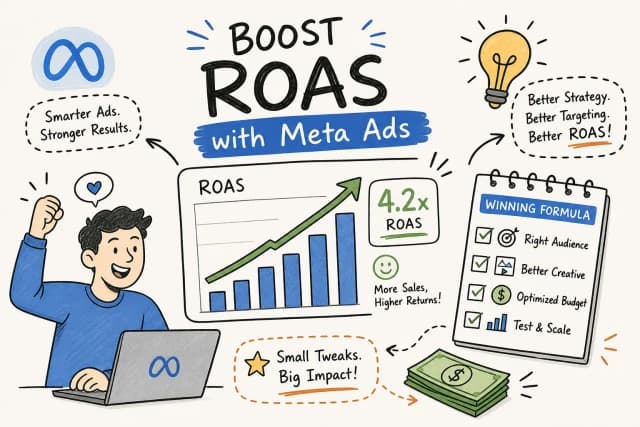
Many Nigerian brands running Meta ads are losing money, and the reason is not Meta. After managing Meta campaigns at ThinqMedia across e-commerce, fintech, real estate, and SaaS verticals, one pattern shows up repeatedly: the same structural and creative mistakes appear across many budgets and industries we have audited. These meta advertising tips are built around what actually separates profitable accounts from bleeding ones. Profitable accounts get the fundamentals right before they scale. Bleeding accounts skip the basics and wonder why the algorithm will not cooperate.
These 15 meta advertising tips are organised by category so you can identify and fix the biggest leaks in your current setup first. Work through tracking, then structure, then creative. Most of the gains come from decisions that cost nothing but attention and discipline.
Meta advertising tips: Build your tracking foundation before spending a naira on ads (Tips 1, 3)
Every optimisation action in this article becomes worthless without accurate data flowing into your account. If Meta cannot see what happens after someone clicks your ad, it cannot optimise delivery toward the outcomes you actually want. These three tracking actions form the non-negotiable baseline of any profitable Meta campaign.
1. Install Meta Pixel correctly on every key page of your site
Create the Pixel in Events Manager, place the base code on every page, and configure the standard events your funnel requires. For e-commerce: PageView, ViewContent, AddToCart, InitiateCheckout, and Purchase. For service businesses: Lead and Contact. The Purchase event must fire only on the confirmed order confirmation page, not when checkout begins. Firing it too early inflates your conversion count and corrupts the signals Meta uses to find buyers.
2. Add the Conversions API to close the browser-tracking gap
If your store uses Paystack or Flutterwave, your browser Pixel is missing a significant share of completed purchases. When a user is redirected to an external payment gateway, the browser session breaks and the Purchase event never fires. The Conversions API (CAPI) solves this by sending the Purchase event from your server after the payment webhook confirms success, not from the browser. Activate it in Events Manager, connect it to your server, and use the server-confirmed Purchase as your conversion trigger, not a client-side page load that may never happen.
3. Verify every event with Pixel Helper and Test Events before going live
Install the Meta Pixel Helper Chrome extension to confirm the correct Pixel ID and event names are firing on each page. Then open Test Events in Events Manager and walk through your funnel in real time, confirming the correct firing order: ViewContent, AddToCart, InitiateCheckout, then Purchase. Duplicate events or events firing out of sequence are clear signals that your setup is broken and needs fixing before you spend a single naira on traffic.
Structure your campaigns so Meta's algorithm can actually learn (Tips 4, 6)
A well-tracked account can still underperform if the campaign structure is working against Meta's machine-learning system. These structural decisions determine whether your budget reaches the learning phase quickly or resets in an endless loop.
4. Match your campaign objective to your actual business goal
A Traffic campaign optimised for clicks will find the cheapest clicks, not buyers. A Sales campaign optimised for Purchase events will find people who buy. The cost of an objective mismatch is real: you can spend an entire month paying for traffic that never converts because the algorithm is doing exactly what you instructed it to do. Set the objective from the moment you create the campaign and do not change it mid-flight without understanding the reset consequences.
5. Run fewer ad sets with more creative options inside each one
Too many ad sets split your budget and slow the learning phase. A practical structure for 2026 is fewer ad sets, each containing several creative variations, commonly two to five, so Meta has enough delivery volume per ad set to identify winning creatives quickly. Every significant change you make to an ad set, including a budget increase above 20 percent, risks triggering a learning reset that sets performance back by days. Keep the structure simple and let creative variety do the testing work.
6. Use Advantage+ for proven offers; use manual campaigns for new tests
Advantage+ Shopping and Sales campaigns work well when your offer is validated, your Pixel signals are strong, and your goal is to scale conversion volume efficiently. When you are testing a new product angle, creative direction, or audience hypothesis, however, a manual campaign gives you the tighter control needed to isolate what is actually working. Use Advantage+ to scale what is proven; use manual setups to run structured experiments.
Meta advertising tips for creative that converts on every placement (Tips 7, 10)
Creative is the highest-leverage variable in any Meta campaign. These four tips cover format, hooks, refresh timing, and content mix, focusing on what the algorithm rewards and what Nigerian audiences actually respond to. Applying these Meta ads tips to your creative production process is one of the fastest ways to improve ROAS without touching your budget.
7. Shoot vertical first: 9:16 for Reels and Stories, 4:5 for Feed
The majority of Nigerian Meta users consume content on mobile. Designing ads for desktop first wastes screen real estate and reduces your creative's competitiveness across the most-trafficked placements. Use these specifications as your 2026 baseline:
Placement Recommended spec Aspect ratio Reels and Stories (video) 1080 × 1920 px 9:16 Feed video and image 1080 × 1350 px 4:5 Feed carousel 1080 × 1080 px 1:1
8. Write and film hooks that stop the scroll within the first three seconds
The opening frame of every video ad is the most important creative decision you will make. A strong hook for Nigerian audiences typically falls into one of four patterns: a bold, counterintuitive statement; a culturally familiar reference or local context; a problem-first opening that names a specific pain point; or a surprising visual that disrupts the viewer's passive scrolling state. Test at least two distinct hook approaches in every creative batch. The hook that wins most of the time is rarely the one that feels safest in the brief.
9. Refresh creatives based on fatigue signals, not a fixed schedule
The fatigue indicators that matter in Meta Ads Manager are a CTR drop of 15 to 25 percent below the ad's own baseline, frequency climbing above 3.0 in cold audience campaigns, CPM rising without a targeting or budget change, and CPA trending upward while your landing page remains unchanged. These thresholds are practitioner benchmarks rather than universal cutoffs, so treat them as starting points and calibrate against your own account history. Refreshing creatives on a fixed weekly calendar kills high performers too early and holds onto fatigued ones too long. Watch performance data daily and act when the numbers signal fatigue, not when the calendar says it is time.
10. Test UGC-style content alongside polished brand visuals
Raw, testimonial-style, or customer-recorded content often outperforms studio-quality creative in Nigerian Meta campaigns, particularly at the prospecting stage. Authenticity signals trust, and audiences on Meta are primed to scroll past anything that resembles a traditional advertisement. Include at least one UGC-style creative in every prospecting test batch alongside your polished visuals, and let performance data decide which direction earns a larger share of the budget.
Reach the right people with a smarter audience sequence (Tips 11, 13)
Audience selection is where many Nigerian SMEs burn the most budget. The correct targeting hierarchy for 2026 follows a clear sequence based on intent proximity, not on the widest possible reach.
11. Start with warm retargeting to get the fastest ROAS wins
Website visitors, video viewers, Instagram and Facebook engagers, and WhatsApp clickers have already shown interest in your brand. They are the fastest path to a positive ROAS because you are following up, not introducing yourself. Build these custom audiences in Meta's Audience Manager and start with 14- to 30-day engagement windows as a baseline for Nigerian buying cycles, then adjust based on the consideration period typical for your product or service.
12. Build lookalikes from your best buyers, not your entire email list
A lookalike built from all website visitors finds people who browse. One built from purchasers or high-LTV customers finds people who buy. The technical minimum seed size for a Nigerian lookalike is 100 matched users, but 1,000 or more is the practical threshold for consistent performance. Use purchaser lists or high-value customer segments as your seed, start with 1 to 3 percent lookalike ranges, and resist the temptation to use general subscriber lists that dilute the quality signal.
13. Use interest targeting as a testing bridge, not a permanent strategy
Interest layers are useful when your Pixel lacks sufficient conversion data for the algorithm to find buyers on its own. They serve as a temporary scaffold, a bridge, not a destination. Once your account generates roughly 50 purchase events per week, broad or Advantage+ targeting typically outperforms interest-heavy setups because Meta's algorithm identifies patterns in real buyer behaviour that interest categories cannot replicate. Shift away from interest layers gradually as your Pixel accumulates purchase signals, and treat this shift as a sign of a maturing account.
Manage your budget and scale without burning what you have worked to build (Tips 14, 15)
Scaling a Meta campaign is where profitable accounts become unprofitable if handled without discipline. These two tips cover the guardrails required to grow ad spend without resetting the performance you have worked to build.
14. Set a ROAS floor before touching your budget
Before you scale any campaign, define the minimum ROAS you are willing to accept as a guardrail. At ThinqMedia, this metric sits at the centre of every scaling decision: campaigns below the ROAS floor receive creative and offer refinement first; campaigns above it become candidates for budget increases. Use 30-day blended ROAS rather than 7-day ROAS for scaling decisions, since short attribution windows can be distorted by delays and day-of-week variance that do not reflect true campaign health.
15. Increase budgets gradually using the 20% rule and automated rules
Increasing a daily budget by more than 15 to 20 percent at a time risks pushing the ad set back into the learning phase. Use Meta's automated rules inside Ads Manager to schedule budget increases tied to performance thresholds rather than manual judgment. A rule that raises budget by 15 percent when 7-day ROAS exceeds your floor removes gut-feel decisions from the scaling process and keeps performance stable as spend grows.
Track the metrics that actually tell you if your Meta ads are working
Knowing which numbers to watch is the difference between making informed decisions and reacting to noise. The metrics that reflect real business outcomes go well beyond CTR and CPM.
Move from CTR to CPA, ROAS, and marketing efficiency ratio
Click-through rate tells you how compelling your creative is. It does not tell you whether you are making money. The metrics that matter are CPA (cost per acquisition), ROAS (revenue generated per naira of ad spend), and MER (total revenue divided by total marketing spend across all active channels). For Nigerian DTC brands and service businesses running multiple paid channels simultaneously, MER captures the full picture and prevents over-attribution to a single platform that may not deserve full credit for the revenue it claims.
Watch frequency and learning phase status every week
Two account health checks should happen weekly without fail. First, check frequency: for cold audiences, keep it below 3.0 before performance starts to deteriorate noticeably. Second, check learning phase status: an ad set stuck in learning signals insufficient budget relative to your CPA target, too many recent edits, or a conversion event that does not generate enough weekly volume for Meta to optimise. Each cause has a different corrective action, so diagnose before you act.
What good performance looks like for Nigerian Meta campaigns
For Nigerian e-commerce, a healthy blended ROAS sits between 2.0x and 6.0x, with CPAs ranging from roughly ₦2,500 for retargeting to ₦18,000 for cold prospecting depending on the product and funnel. For lead generation verticals, a CPL of ₦1,200 to ₦6,000 is a functional reference range across financial services, real estate, and education. What matters more than matching a benchmark is whether your CPA is at or below your acquisition target, your frequency is below 3.0, and your cost-per-result is flat or declining week over week. Consistent, structured tracking is what separates brands that scale from brands that plateau, and it is the foundation of every reporting dashboard ThinqMedia builds for managed accounts.
The five areas that determine whether your Meta spend is profitable
These 15 Meta advertising tips cover tracking, campaign structure, creative, audience sequencing, and measurement. None of them require a large budget. All of them require consistent execution and a willingness to read data honestly and adapt when the numbers change.
The brands winning on Meta in Nigeria are not the ones spending the most. They are the ones who built a clean tracking foundation, structured their campaigns to work with the algorithm rather than against it, tested creative systematically, and set clear performance guardrails before scaling a single naira of spend. These are the same Facebook ads best practices that underpin every account ThinqMedia manages, straightforward in principle, demanding in execution.
If your Meta campaigns are spending without returning consistent results, a structured performance audit is the fastest way to identify exactly where the leaks are and what to fix first. Apply these Meta advertising tips to your current setup, or get in touch with ThinqMedia to discuss a managed Meta campaign service built around the same tactics outlined here.
Admin Strategist
Thinq Media Strategy