Financial Services Campaign Insights: 3-Platform Case Study
In today’s digital marketing landscape, running successful campaigns is no longer just about impressions or clicks. The real challenge lies in balancing awareness, engagement, and meaningful user actions across multiple platforms while adapting to different audience behaviors.
Recently, I led and managed a multi-platform financial services campaign executed across Facebook, Instagram, and YouTube. The campaign was designed to drive awareness, generate traffic, and encourage landing page engagement for a business-focused financial product targeted at entrepreneurs, professionals, and financially active audiences.
What stood out most from this campaign was not just the scale of delivery, but the clear behavioral differences across platforms and how each platform contributed differently to the campaign objective.
Campaign Overview
The campaign ran across:
Facebook
Instagram
YouTube
The primary objective was to drive:
Awareness
Traffic
Landing page engagement
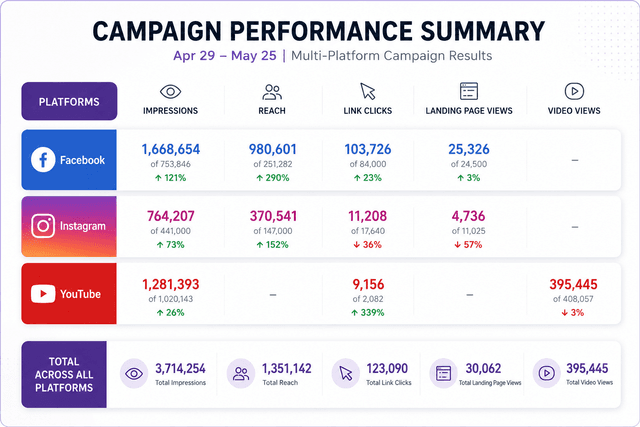
At the end of the campaign, the combined performance delivered:
Over 3.7 million impressions
Strong audience reach across all platforms
More than 123,000 combined clicks
Significant landing page engagement
Key Campaign Achievements
1. Facebook Emerged as the Strongest Performance Driver
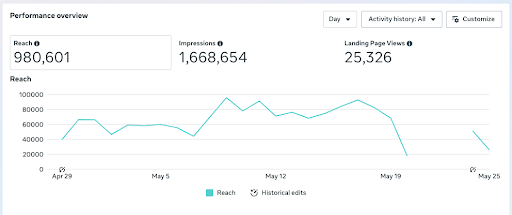
Facebook significantly outperformed expectations across almost all major KPIs.
The platform generated:
1.6M+ impressions
980K+ reach
103K+ link clicks
25K+ landing page views
One of the most important takeaways here was the efficiency of Facebook traffic. Not only did the platform generate high click volume, but users were also more likely to complete the landing page load process after clicking the ads.
This indicates stronger lower-funnel intent and better traffic quality compared to the other platforms.
Another positive indicator was the campaign frequency, which remained stable throughout delivery. This showed that the campaign maintained healthy visibility without overexposing users to the ads.
2. Instagram Delivered Strong Visibility but Different User Behavior

Instagram exceeded its planned targets for impressions and reach, generating:
764K+ impressions
370K+ reach
However, landing page views underdelivered compared to projections.
While this may initially look like a performance issue, the data actually revealed something more important: platform behavior differences.
Instagram users engaged well with the creatives and generated over 11,000 clicks, but a larger percentage dropped off before completing the landing page load process.
This is a common trend on Instagram, where users tend to engage more with content consumption and in-app behavior than with lower-funnel actions.
This finding reinforced an important marketing reality:
High engagement does not always translate directly into conversion efficiency.
3. YouTube Delivered Exceptional Engagement Efficiency
YouTube also produced an impressive awareness performance.
The platform generated:
1.28M+ impressions
395K+ video views
9,156 clicks
One of the strongest signals from YouTube was the click performance, which exceeded the planned target significantly.
This suggests that the video creative resonated strongly with audiences and successfully encouraged user interaction beyond passive viewing.
Audience Insights and Behavioral Patterns
Another interesting finding from the campaign was the demographic split across platforms.
Facebook engagement skewed heavily toward men aged 18–45, while Instagram recorded stronger engagement among women within the same age range.
This reinforced the importance of platform-specific messaging and audience segmentation when running multi-platform campaigns.
Different audiences consume and respond to content differently depending on the platform environment.
Major Lessons From the Campaign
1. Platform Intent Matters
One of the biggest lessons from this campaign is that every platform serves a different role within the customer journey.
Facebook proved stronger for lower-funnel traffic behavior.
Instagram excelled more in visibility and engagement.
YouTube delivered strong awareness and video engagement.
Treating all platforms the same often leads to poor optimization decisions.
2. Traffic Volume Alone Is Not Enough
Generating clicks is important, but what happens after the click matters even more.
The difference between clicks and completed landing page views on Instagram highlighted the importance of:
Landing page optimization
User intent
Platform behavior
Mobile experience
3. Creative Relevance Still Wins
The campaign’s strong engagement performance across all platforms showed that relevant messaging and platform-native creatives continue to outperform generic advertising approaches.
Users respond better when messaging aligns with their behavior, expectations, and mindset on each platform.
Final Thoughts
Overall, the campaign successfully achieved its core objective of driving awareness, engagement, and high-volume traffic across Facebook, Instagram, and YouTube.
More importantly, it provided valuable insight into how audiences behave differently across platforms and how campaign optimization should adapt accordingly.
Digital campaigns are no longer just about “running ads.”
The real advantage comes from understanding audience psychology, platform behavior, and conversion intent, then using those insights to continuously improve campaign performance.
That’s where the real growth happens.
Admin Strategist
Thinq Media Strategy