How Much Does It Cost to Advertise on Facebook and Instagram in Nigeria? A Complete Guide with Real Campaign Data and Budget Benchmarks
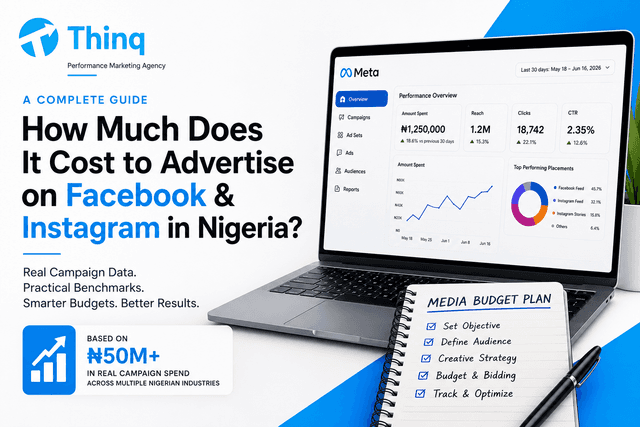
One of the first questions every business owner asks before running Facebook or Instagram Ads is:
"How much is this going to cost me?"
It's a fair question.
Whether you're a startup trying to generate your first leads, an established company planning a nationwide campaign, or a marketing manager preparing next quarter's budget, understanding the cost of Meta advertising is an important part of making informed business decisions.
The problem is that most articles don't really answer the question.
You'll often find vague responses like:
"It depends on your industry."
"It depends on your audience."
"It depends on your objective."
While those statements are true, they aren't particularly helpful if you're trying to decide whether you should budget ₦200,000 or ₦2 million for your next campaign.
This guide is different.
Rather than relying solely on generic industry averages, the insights shared here are based on campaigns I've managed across multiple industries in Nigeria, including banking, finance, insurance, education, healthcare, real estate, hospitality, FMCG, NGOs, e-commerce, and more.
Over the years, I've managed more than ₦50 million in Meta advertising spend, helping businesses improve awareness, generate qualified leads, drive website traffic, increase app installs, and achieve measurable marketing objectives.
My goal isn't simply to tell you how much Meta Ads cost.
It's to help you understand why they cost what they do, how to budget realistically, and what separates businesses that get results from those that simply spend money.
By the end of this guide, you'll understand:
What determines Facebook and Instagram advertising costs in Nigeria.
Typical CPM, CPC, and Cost per Lead benchmarks.
How much different advertising budgets can realistically achieve.
Common mistakes that increase advertising costs.
How to budget more effectively before launching your next campaign.
If you're planning to advertise on Facebook or Instagram, this guide will help you make better decisions before spending your first naira.
Before We Talk About Costs...
There's something important you need to understand.
If someone tells you:
"Facebook Ads cost exactly ₦100 CPM."
or
"Your Cost per Lead will definitely be ₦5,000."
be careful.
Meta advertising doesn't work that way.
Unlike traditional advertising, where you buy fixed placements at fixed prices, Meta uses a real-time auction system.
Every advertiser competes for attention.
That means advertising costs are constantly changing.
Think of it like airline tickets.
A Lagos to Abuja flight might cost one amount today and something completely different next week.
The destination hasn't changed.
Demand has.
The same principle applies to Meta Ads.
A Note About the Benchmarks in This Guide
Before we dive into numbers, it's important to understand how to interpret the benchmarks throughout this article.
The figures shared here are based on campaigns managed by Thinq Media across multiple industries in Nigeria and should be treated as planning benchmarks, not fixed prices.
Actual advertising costs can vary depending on several factors, including:
Your campaign objective.
Your industry.
Audience competition.
Creative quality.
Ad placements.
Seasonality.
Campaign optimisation.
The prevailing USD/NGN exchange rate.
For example, I may prepare a media plan for a client when the exchange rate is ₦1,500 to $1.
If the client approves the campaign several weeks later and the exchange rate has increased to ₦1,600 to $1, the estimated campaign cost in naira will also increase, even if nothing else changes.
This is one of the reasons media plans should always be reviewed before campaigns go live.
Throughout this guide, think of the benchmark ranges as realistic planning estimates rather than guaranteed advertising costs.
Why Does the Dollar Exchange Rate Affect Meta Ads in Nigeria?
This is one of the biggest reasons advertising budgets change unexpectedly.
Many advertisers prepare their annual marketing budgets months before campaigns actually begin.
During that time, exchange rates can change significantly.
Because Meta's advertising platform operates internationally, fluctuations in the value of the naira directly affect how much businesses pay.
Let's use a simple example.
Imagine your planned advertising budget is equivalent to $1,000.
If the exchange rate is:
₦1,500 = $1
your estimated advertising budget becomes:
₦1,500,000
Now imagine the campaign is delayed by one month.
The exchange rate rises to:
₦1,650 = $1
That same campaign now requires approximately:
₦1,650,000
Nothing changed about:
your audience,
your campaign objective,
your creatives,
or your strategy.
The only difference was the exchange rate.
This is why experienced agencies regularly review media plans before launching campaigns instead of relying on budgets created weeks or months earlier.
What Determines the Cost of Facebook and Instagram Ads?
One of the biggest misconceptions about Meta advertising is that there is a standard price.
There isn't.
The amount you pay depends on how competitive your campaign is compared to other advertisers targeting similar audiences.
Here are some of the biggest factors that influence advertising costs.
1. Campaign Objective
Your campaign objective is one of the strongest drivers of cost.
For example:
An Awareness campaign is usually cheaper than a Lead Generation campaign because Meta is simply trying to maximise reach and impressions.
A Lead campaign, on the other hand, asks Meta to find people who are more likely to submit their details.
That requires more sophisticated optimisation, which often increases costs.
Choosing the wrong campaign objective is one of the fastest ways to waste advertising budget.
In fact, based on my experience, it's one of the main reasons some businesses spend ₦2 million and achieve worse results than businesses spending ₦500,000.
The budget wasn't the problem.
The strategy was.
2. Your Audience Strategy
Your audience strategy still influences advertising costs, but not in the same way it did a few years ago.
Today, Meta increasingly relies on AI-powered optimisation through features like Advantage+ Audience, which allows the platform to expand beyond your initial audience suggestions to find people who are more likely to achieve your campaign objective.
However, that doesn't mean audience selection no longer matters.
Your campaign objective, audience signals, customer lists, pixel data, and conversion history all help Meta understand who it should prioritise.
For example, a campaign aimed at decision-makers in the financial services sector may still compete in a more valuable advertising environment than a campaign targeting a broader consumer audience.
Rather than thinking about audience targeting as selecting the "perfect audience," think of it as providing Meta with the strongest possible signals. The better the signals you provide, the better Meta's AI can optimise delivery over time.
3. Industry Competition
Not every industry pays the same amount for advertising.
Some industries naturally attract more competition than others.
For example, sectors such as:
Insurance
Real Estate
Financial Services
often experience higher advertising costs because multiple companies compete for the same high-value prospects.
On the other hand, some industries may generate leads at a lower cost because competition is less intense.
Understanding your industry's benchmark helps you set realistic expectations before launching a campaign.
4. Creative Quality
Many advertisers assume that increasing their advertising budget automatically improves results.
In reality, that's rarely the case.
Your creative is one of the biggest factors influencing campaign performance. Even with the same audience and budget, two different creatives can produce completely different outcomes.
Strong creatives typically lead to:
Higher engagement
Better click-through rates (CTR)
Lower advertising costs
More conversions
Weak creatives often produce the opposite, resulting in lower engagement and higher costs.
The Meta algorithm rewards ads that people respond to. When users engage positively with your content, your campaigns generally become more efficient over time.
This is one of the reasons creative testing has become such an important part of performance marketing.
Meta Ads Manager now includes AI-powered tools that can analyse different versions of your creatives and provide insights into which ones are more likely to drive stronger results, such as higher click-through rates, more video views, or better overall performance. These recommendations help advertisers identify what is working and make informed decisions without relying solely on guesswork.
Rather than launching a single image or video, I recommend testing multiple creative variations. Sometimes, a simple change to the headline, primary text, image, or call to action can significantly improve campaign performance without increasing your budget.
5. Campaign Optimisation
Launching a campaign isn't the end of the job.
It's the beginning.
The best-performing campaigns are continuously optimised by reviewing data such as:
CPM
CPC
CTR
Frequency
Landing Page Views
Cost per Lead
and making adjustments based on performance.
Businesses that launch campaigns and never optimise them usually pay more over time than those that actively improve them.
One Lesson I've Learned After Managing More Than ₦50 Million in Meta Ads
If there's one lesson that consistently holds across industries, it's this:
Ads don't create demand. They amplify it.
A successful Meta campaign doesn't begin inside Ads Manager.
It begins long before the campaign is launched.
If your product isn't available, your website lacks credibility, your sales team responds slowly, or there's no follow-up process, advertising won't fix those problems.
It will simply expose them to more people.
I've seen businesses spend substantial advertising budgets only to generate little or no revenue, not because Meta Ads failed, but because the business wasn't prepared to convert the attention it paid for.
That's why I always encourage clients to strengthen their internal processes before increasing their advertising budget.
Great advertising amplifies great businesses.
It struggles to rescue broken systems.
Admin Strategist
Thinq Media Strategy