How to Run Meta Ads for Ecommerce (That Actually Convert)
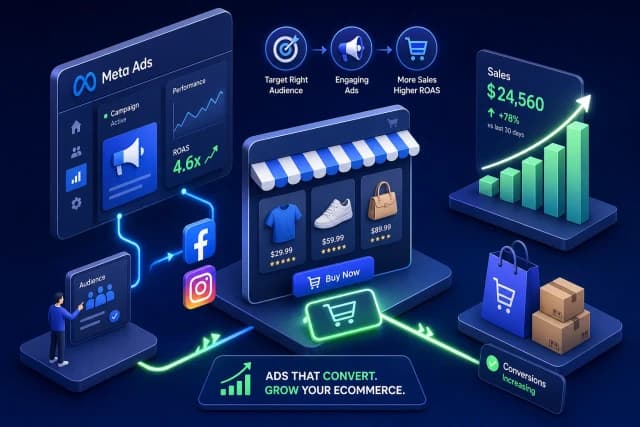
Many e-commerce brands running Meta ads for e-commerce are not losing because of bad products or wrong audiences. They are losing because they do not have a system. What separates stores that scale profitably from those that burn through budget and stall is a full-funnel Meta advertising structure: the right campaign layers working together, tracking that actually captures what is happening, and creatives built for each stage of the buying journey.
This guide walks you through how to build that system from scratch. It covers Pixel and Conversions API setup, campaign architecture, prospecting creative, retargeting sequences, and catalogue ads, so your Meta programme produces measurable, consistent revenue rather than just impressions. The framework below reflects what conversion-first performance teams use to take e-commerce brands from inconsistent ROAS to predictable, scalable growth on Meta.
Why your tracking setup determines everything else
Before you touch campaign structure or creative, your tracking foundation has to be solid. If your Pixel is firing incorrectly or your purchase events are underreporting, Meta's algorithm is optimising towards incomplete data. That means your bids, your audience signals, and your reported ROAS are all off from the start.
The difference between Meta Pixel and Conversions API
The Meta Pixel is a browser-side tag that tracks user actions on your site, but browser tracking has become less reliable as iOS privacy changes and ad blockers erode signal quality. Conversions API (CAPI) sends event data directly from your server to Meta, bypassing the browser entirely. This setup, known as redundant deduplication, gives Meta the strongest possible signal for optimisation.
How to set this up on Shopify and WooCommerce
On Shopify, the cleanest path is through the Facebook and Instagram sales channel. Go to Sales Channels, open Settings, navigate to Data Sharing, toggle on "Enable data sharing," and set the level to Maximum. Then select your Meta Pixel from the list and confirm. This single setting activates both browser and server-side tracking in one step.
On WooCommerce, install the official Meta for WooCommerce plugin, connect your Meta Business account, select or create a Pixel, and enable the Conversions API option inside the plugin settings. After setup on either platform, verify that PageView, ViewContent, AddToCart, and Purchase events are all appearing in Meta Events Manager with no duplicate purchase events firing. Meta's own documentation warns that skipping this verification step risks optimising towards inflated purchase counts, which distorts your target CPA and misleads scaling decisions.
Meta ads for ecommerce: campaign structure and full-funnel architecture
A full-funnel Meta campaign structure is not complicated. It is three distinct layers running simultaneously, each with a specific job, and each funded according to its role in the buying journey. A common reason accounts underperform is not poor targeting; it is that all their budget sits in one campaign doing two contradictory jobs at once.
Prospecting with Advantage+ Shopping campaigns
The Advantage+ Shopping Campaign (ASC) is Meta's automated prospecting tool and the most efficient way to find new customers at scale. It automatically handles audience discovery, placement optimisation, and creative serving. For most e-commerce accounts, ASC should absorb 60 to 70 percent of total ad spend. Set your primary conversion event to Purchase and let the campaign optimise, resisting the urge to narrow the audience or stack manual targeting on top. According to Meta's learning phase guidelines, each ad set needs approximately 50 purchase events within a seven-day window to exit the learning phase and perform reliably; in practice, a campaign-level target of 30 to 50 events per week is a reasonable working threshold when volume is still building.
Retargeting: converting warm traffic
Your retargeting campaign targets people who have already engaged: site visitors, product page viewers, add-to-cart users, and video viewers. This layer typically runs on 15 to 25 percent of your budget. Keep retargeting completely separate from prospecting to avoid audience overlap and to maintain clean cost-per-acquisition data. Audience windows of 7 to 14 days tend to outperform broader 30-day windows for warm e-commerce traffic, particularly on lower-ticket items where purchase intent decays quickly. In practice, across ThinqMedia client accounts, 7-day audiences convert at roughly 4.2 percent against 2.4 percent for 30-day windows in lower-ticket categories, though results vary by vertical and price point.
Catalogue ads as your always-on automation layer
Advantage+ Catalogue ads, formerly known as Dynamic Product Ads, pull directly from your product feed and serve relevant products to users based on their browsing behaviour. They are the most automated format in the Meta ecosystem and work across both prospecting and retargeting objectives. For retargeting, catalogue ads are particularly powerful for cart abandoners, showing the exact product a user viewed or added to cart, with price and availability updated automatically from the feed. This is where Facebook ads for e-commerce and Instagram shopping ads converge most naturally; a single well-maintained catalogue feed powers placements across both platforms without additional creative production.
Prospecting creatives for Meta ads for ecommerce
Cold traffic does not know your brand, so your creative has to stop the scroll and establish relevance before the viewer has any reason to keep watching. Format and framing matter as much as the offer itself. A technically correct campaign structure with weak creative will still underperform, regardless of how well the backend is set up.
Video and UGC for cold audience prospecting
Short-form vertical video is the dominant prospecting format in 2026, particularly on Instagram Stories, Reels, and the Facebook feed. Aim for 9:16 creative that fills the full phone screen. Hook with motion in the opening one to two seconds, lead with the problem your product solves rather than the brand name, and include on-screen captions because most users watch without sound. Keep prospecting video under 30 seconds, with the core message delivered in the first 15. For cold audiences, hooks built around direct address or specific outcome framing consistently outperform generic brand introductions; "still waking up exhausted every morning?" tends to outperform "introducing our new wellness product" because specificity creates immediate relevance.
Static and carousel formats still have a place
Static image ads remain efficient for direct-response prospecting, particularly when the offer is strong and visually clear. Carousel ads work well for showcasing multiple products or explaining a multi-step benefit, and they consistently perform on Facebook feeds where users are more likely to swipe through. Build your creative in batches, testing hook, format, and offer as separate variables so you can isolate what is actually driving performance. Refresh assets every seven to ten days to prevent ad fatigue from suppressing performance as frequency rises.
Retargeting sequences and catalogue ads that close sales
Retargeting is where you recover revenue that would otherwise be lost. Many e-commerce stores run a single retargeting ad and treat it as a sequence. A properly built sequence uses different creative and messaging at each stage, based on how recently and how deeply a user engaged with your brand.
Building a three-stage retargeting sequence
The first stage targets recent site visitors within seven days with brand or social-proof-led creative: reviews, testimonials, and unboxing content. Users who reached checkout but did not purchase form your most valuable retargeting cohort, serve them urgency-led creative with limited stock signals or expiring offers, since purchase intent is highest and the barrier is lowest. Between those two groups, add-to-cart and product page viewers respond well to objection-handling messaging: satisfaction guarantees, free shipping reminders, or a clear articulation of the product's value relative to its price. Each stage should have its own ad set so you can see performance individually and allocate budget where the conversion rate is highest.
Making catalogue and dynamic product ads work harder
To get the most from catalogue ads, your product feed needs to be clean: accurate titles, clear images with no text overlays, correct prices, and proper categorisation. Pair catalogue ads with retargeting audiences based on ViewContent and AddToCart events for the highest relevance match. It is worth testing price-drop overlays or review ratings directly on the catalogue ad creative using Meta's catalogue enhancement options; these additions can improve click-through rates on competitive product categories without requiring manual creative production for each SKU, though the actual uplift will depend on your category and audience.
Budget allocation and scaling without losing profitability
Knowing how to allocate and scale your budget is as important as the structure itself. A common mistake is spreading budget too thin across too many campaigns before any single layer has enough signal to perform consistently.
Starting budget splits for a new Meta e-commerce account
A practical starting allocation for most e-commerce stores is 60 to 70 percent in prospecting via ASC, 15 to 25 percent in retargeting, and 10 to 20 percent in creative testing or seasonal promotions. If your overall budget is limited, do not force the full three-layer structure immediately. Focus primarily on ASC until you are generating enough purchase volume for Meta's algorithm to stabilise, then add retargeting once data is flowing and purchase events are consistent.
When and how to scale spend
Scale budgets incrementally: increase by 20 to 30 percent per week rather than doubling spend overnight. Aggressive budget jumps reset the learning phase and often cause CPA spikes that take days to recover from. When an ASC campaign is performing consistently at or below your target CPA, increase the budget and monitor for 48 to 72 hours before making another change. On the creative side, always have at least two or three fresh assets in rotation before scaling, so ad fatigue does not become the bottleneck as reach expands.
Measuring success with Meta ads for e-commerce
Data tells you what is working, but only if you are looking at the right signals. Many e-commerce stores focus too heavily on platform-reported ROAS and miss the attribution nuances that lead to better scaling decisions.
ROAS benchmarks to contextualise your performance
Meta e-commerce ROAS benchmarks in 2026 cluster around 1.9x to 2.8x at the median across broad categories. Fashion and apparel typically land between 2.2x and 4.3x; beauty and skincare between 1.5x and 4.2x; home and garden between 2.2x and 3.9x. These are useful reference points, but your target ROAS should be calculated from your own margin structure, not from industry averages. A 2.0x ROAS on a high-margin product can be far more profitable than a 3.5x ROAS on a razor-thin-margin item, and conflating the two leads to poor budget decisions.
Attribution signals that actually drive better decisions
Platform-reported numbers and actual backend revenue will never be identical. The gap between the two is where many brands make poor scaling decisions. The approach that closes that gap is layering your Meta attribution window data against your backend revenue from Shopify or WooCommerce and reconciling the two on a regular cadence.
At ThinqMedia, this week-by-week attribution reconciliation is standard practice for e-commerce clients, and it is consistently what separates accounts that scale confidently from those that pause spend every time ROAS dips for a day. Track your new customer CAC separately from returning customer revenue, and watch for creative fatigue signals such as rising frequency, falling CTR, and rising CPM.
Review performance at the ad creative level, not just the campaign level. The creative is almost always where the real answer lives, and isolating it as a distinct variable is what makes scaling decisions defensible rather than reactive.
Build the system, then let it compound
Building a profitable Meta advertising programme for your e-commerce store is not about finding a single winning ad. It is about building the right structure: clean tracking with Pixel and CAPI, a three-layer campaign architecture, creatives matched to each funnel stage, disciplined budget allocation, and attribution data that reflects real revenue. That is the foundation of any Meta ads for e-commerce system that scales reliably.
Each layer reinforces the others. When they work together, Meta becomes one of the most scalable paid acquisition channels available to e-commerce brands, whether you are selling in Lagos, Abuja, or scaling cross-border. Start with the tracking foundation, build your campaign layers one at a time, invest in creative testing, and let data drive your scaling decisions rather than instinct.
If you want a second pair of eyes on your Meta account structure, the team at ThinqMedia works with e-commerce brands daily to do exactly this. Get in touch, and we will review your current account structure against the framework above.
Admin Strategist
Thinq Media Strategy