Media Planning vs Media Buying: What's the Difference?
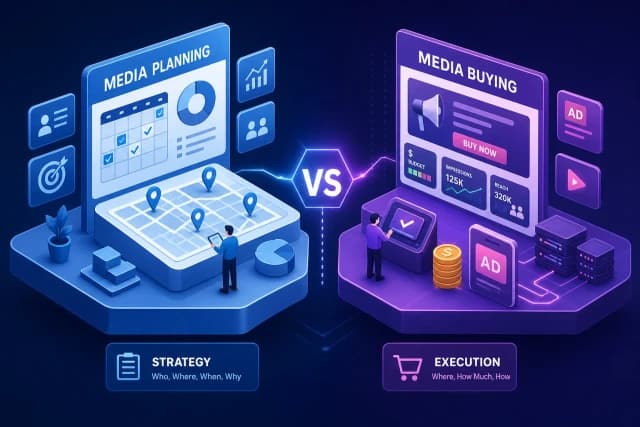
Media planning vs media buying is a distinction many Nigerian business owners running paid ads tend to overlook. Most can tell you roughly how much they're spending each month. Far fewer can tell you whether their biggest problem is advertising in the wrong places, or that their ads are being bought and managed poorly. The fix for each problem is completely different. One is a strategy failure. The other is an execution failure. Confusing the two leads to months of wasted budget and no clear explanation for why campaigns aren't working.
The simplest way to frame it: media planning is the strategy that decides where your money should go and why, while media buying is the execution that makes sure it actually gets there efficiently. Both functions are essential, but they operate at different levels and are measured by different things. When they're aligned, campaigns tend to produce more consistent, predictable results, stable cost-per-acquisition ranges, and reliable reach targets hit on schedule. When they're disconnected, even a healthy ad budget can underperform quietly for months. The brands that consistently get strong returns from paid media treat these two functions as a single connected process rather than two separate handoffs handled by different people with different priorities.
By the time you finish reading this, you'll understand exactly what each function covers, which metrics belong to which role, and why the structural relationship between strategy and execution determines your campaign outcomes more than budget size ever will.
Media Planning vs Media Buying: Understanding What Each Function Involves
The media planner's core job
A media planner operates entirely on the strategy side of advertising. Their job is to research the target audience, identify the most effective channels to reach them, set realistic budgets, define campaign timelines, and build the rationale that justifies every recommendation. The output of their work is a media plan: a structured document that answers where, when, and why a brand should advertise. None of this involves spending any money yet.
It's the thinking that happens before a single naira goes to a platform. A strong media planner draws on audience data, channel performance benchmarks, competitor activity, and an understanding of how different platforms serve different stages of the customer journey. They translate a brand's commercial objective into a campaign architecture that gives the buying team a clear brief to work from.
What a strong media plan covers
A properly built media plan is more than a channel list and a budget spreadsheet. It defines the audience in specific, actionable terms, not just "adults aged 25 to 44" but behavioural and interest-based segments that map to where those people actually spend their time online. It specifies the channel mix (Meta, Google Search, LinkedIn, programmatic display, OOH, or some combination), explains the role each channel plays, allocates budget per channel with justification, and sets reach, frequency, and performance benchmarks before the campaign launches. Think of it as a media planning checklist built into a strategic document: every channel justified, every audience segment defined, every success metric assigned before a single naira is committed.
The media plan is the brief that governs every downstream buying decision. Without it, buyers are making tactical choices in a strategic vacuum, and that's where misalignment begins.
Where media planning ends
A media planner recommends and justifies the approach. They do not place the ads. Once the plan is approved, the execution responsibility moves to the buyer. In smaller teams or fully integrated agencies, the same person may handle both planning and buying, but the functions remain distinct even when the roles overlap. Treating them as identical blurs accountability when something goes wrong, and when budget is on the line, clear accountability matters.
What Media Buying Means in Practice
The media buyer's core responsibilities
Media buying is pure execution. The buyer's job is to take the approved plan and turn it into live campaigns: negotiating ad inventory where applicable, setting up campaigns on Meta Ads Manager, Google Ads, or a DSP (demand-side platform), trafficking creatives to the right placements, monitoring daily delivery pacing, and adjusting bids, targeting, and budget distribution based on what the data shows. They also reconcile billing against what was actually delivered, a step that becomes increasingly consequential when you're managing significant spend across multiple platforms simultaneously.
A media buyer works in the platform on an ongoing, daily basis. Their decisions are granular and operational: which audience segment gets more budget today, which placement is underperforming and should be paused, which creative is fatiguing and needs to be rotated out. Understanding the media buying process at this level of detail is what separates competent execution from costly guesswork.
Programmatic vs direct media buying
There are two main methods for purchasing ad inventory. Programmatic media buying uses automated platforms called DSPs to purchase inventory in real time across thousands of placements and publishers simultaneously. Direct buying involves negotiating placements directly with publishers or platforms, which is more common in traditional media channels like OOH, television, and radio. Performance-driven digital campaigns today predominantly rely on programmatic buying combined with direct platform management through Meta Ads Manager and Google Ads, each of which runs its own automated auction system within its respective ecosystem.
What a media buyer is accountable for
Buyer accountability is defined by execution efficiency. Campaign spend should track within the planned budget. Placements should be secured at competitive rates. Delivery should match the flighting schedule the planner defined, and inventory quality should meet the standards the plan set out. These are operational questions, not strategic ones. A buyer can execute brilliantly against a weak plan and still produce poor business results. Equally, a strong plan executed poorly will fail regardless of how sound the strategy was. That's why the relationship between the two functions, the media planner vs media buyer dynamic, is so consequential.
Media Planning vs Media Buying: The Metrics That Define Success
How you measure media planning performance
Media planning is measured by audience delivery metrics. Reach tells you how many unique people within the target audience were exposed to the campaign at least once. Frequency tells you how often those people saw the ad on average. Effective reach refines this further: it measures what percentage of the target audience saw the ad at a meaningful frequency, typically three or more exposures, though this threshold varies by campaign objective and industry. On-target reach, which measures how much of the delivered audience actually matched the intended demographic, is the final quality check on whether the planning assumptions held up in execution. Together, reach, frequency, and effective reach are the clearest signals that the plan was built correctly and delivered as intended.
How you measure media buying performance
Buying performance is measured by cost efficiency and action efficiency. CPM (cost per thousand impressions) tells you how cheaply you're purchasing exposure. CPC (cost per click) tells you how efficiently you're generating traffic. CPA (cost per acquisition) tells you what each lead, sign-up, or sale is actually costing you. CTR (click-through rate) and conversion rate sit alongside these as diagnostic metrics that help explain whether performance is being driven by audience quality, creative strength, or the efficiency of the buyer's bidding and targeting decisions.
Why using the wrong metrics creates confusion
Many brands apply buying KPIs to judge planning decisions, or use planning metrics to evaluate buying efficiency. This mismatch reliably produces misdiagnosed problems. A brand might question the channel mix when the actual issue is weak bid management on a perfectly sound channel selection. They might blame audience targeting when the real problem is creative fatigue that the buyer should have caught and rotated out two weeks earlier. Getting the right metrics assigned to the right function is the first step toward diagnosing campaign problems accurately and fixing the right thing. This is one of the clearest distinctions in the ad buying vs media planning debate: each discipline has its own success criteria, and conflating them muddies both.
Why Separating the Two Functions Can Damage Campaign Performance
The handoff problem
When media planning and buying are handled by separate teams or separate agencies, something almost always breaks at the handoff. The planner builds a paid media strategy with specific audience intent, channel rationale, and performance assumptions built into every recommendation. The buyer receives a brief and executes it, but without the full context behind the decisions. Small misinterpretations at this stage compound into significant budget waste by the time the campaign is live. The buyer might deprioritise a channel because inventory was expensive on a particular day, without realising that channel was structurally important to the audience sequencing the planner designed.
How strategy drift affects results
Strategy drift happens when buying decisions deviate from the original plan without anyone flagging it as a structural change. A placement gets switched to a cheaper but lower-quality option. A segment gets under-allocated because another segment was converting more easily in the short term. These changes can make sense from a pure buying efficiency standpoint, but they break the strategic logic the planner built. The result is a campaign that technically ran but didn't deliver the outcomes the strategy was designed to produce, and neither team can clearly explain why.
The compounding cost of misalignment
Even small misalignments between planning intent and buying execution accumulate into measurable performance gaps over the life of a campaign. Brands running separate planning and buying functions often can't pinpoint where performance broke down, because accountability is split across two teams with different mandates and different definitions of success. The planner points to reach and frequency numbers that look acceptable. The buyer points to CPM and CPC figures that seem competitive. Meanwhile, the actual business outcome, whether that's leads, sales, or sign-ups, is underperforming and no one owns the gap.
Why an Integrated Model Produces Better Campaign Outcomes
The feedback loop that makes integration work
When one team owns both the strategy and the execution, real-time buying data flows directly back into planning decisions without delay. If a particular audience segment is converting at a lower CPA than projected, budget can be redirected toward it immediately. If a channel is underdelivering on reach targets, the buyer can adjust without waiting for a separate team's approval or a weekly status call. This feedback loop- buying data continuously informing the plan, the plan continuously governing buying decisions- is what separates integrated media management from traditional siloed approaches. It's also what makes performance improve over time rather than plateau.
How ThinqMedia structures planning and buying together
At ThinqMedia, media planning and buying aren't two separate service lines operating in sequence. They're one connected process where the strategic thinking that defines audience targeting and channel allocation directly informs how campaigns are set up, bid against, and optimised on a daily basis. The same strategic logic that built the plan governs every bid adjustment, every audience exclusion, and every creative rotation decision; there's no moment where strategy is handed off to a separate execution team and the context gets lost in translation. For brands that need their media planning and buying to operate as a genuinely unified discipline, that structural integration removes one of the most common and costly causes of campaign underperformance. If that's the model you're evaluating, we're worth a conversation.
What to look for in a media partner
Whether you're working with an agency or building an in-house capability, the key question is straightforward: does the same strategic thinking that created the plan govern how the campaign is being managed day to day? If planning and buying are reviewed by separate people on separate timelines with separate reporting, that gap is where your performance is leaking. The clearest sign of a mature paid media setup is when buying decisions can always be traced back to a planning rationale, and when planning assumptions are always being tested and refined by live buying data.
Bringing It Together: Media Planning and Buying as One System
Media planning decides where your money should go and why. Media buying makes sure it gets there efficiently and effectively. Neither function works at its best in isolation, and most campaign failures can be traced back to a breakdown somewhere in the relationship between the two. From what we observe working with brands across Nigeria, strong campaign returns tend to come not from the biggest budgets, but from advertisers who've made sure their strategy and execution are genuinely working as a single system. Media planning vs media buying isn't a choice between two disciplines; it's a question of how well those two disciplines are integrated.
The most practical takeaway is this: before you question your budget size or your creative quality, ask whether your planning and buying are truly aligned. If the answer is uncertain, that uncertainty is the problem. The strongest outcomes come from finding a partner who treats media planning and buying as one integrated discipline from the first day to the last, backed by data, clear accountability, and daily hands-on management of every campaign decision.
Admin Strategist
Thinq Media Strategy