Why One App Install Campaign Delivered Two Completely Different Outcomes
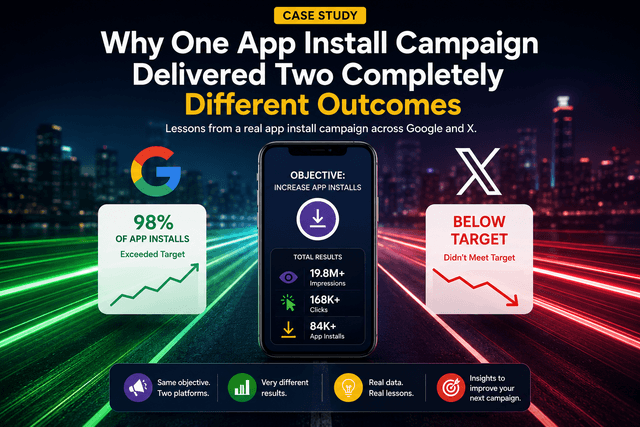
What I learned after running the same app install objective across Google and X.
Performance marketing has a way of keeping you humble.
Just when you think you've figured out a platform, the next campaign reminds you that no two campaigns are ever the same.
Recently, I managed a mobile app acquisition campaign for a financial services company. The objective was straightforward: increase app installs by running an App Promotion campaign on Google and an App Install campaign on X.
On paper, the strategy looked solid. Both platforms had access to the same core objective, similar audience profiles, and creatives designed to drive downloads. I had also managed successful app install campaigns on X in the past, so I expected both platforms to deliver competitive results.
That wasn't what happened.
Same Objective. Very Different Outcomes.
By the end of the campaign, the combined results were impressive:
More than 19.8 million impressions
Over 168,000 clicks
More than 84,000 app installs
At first glance, anyone looking at those numbers would conclude the campaign was a complete success.
But when I broke the data down by platform, a very different story emerged.
Google significantly exceeded its planned KPIs, accounting for approximately 98% of all app installs generated during the campaign. X, on the other hand, delivered substantial awareness and traffic but fell short of its planned install target.
The question wasn't whether the campaign worked.
The question was why two platforms running toward the same objective produced such different outcomes.
Google Was Built for This Objective

One of the biggest takeaways from this campaign is that platform strengths matter.
Google's App Promotion campaigns are designed to optimise for installs across Google Search, Google Play, YouTube, Discover, and millions of partner apps. Its machine learning has access to strong intent signals that help identify users who are more likely to install an app.
The results reflected that advantage.
Google didn't just meet expectations. It significantly exceeded them, delivering far more installs than originally planned while maintaining strong overall campaign efficiency.
Sometimes, the simplest explanation is the right one: the platform was exceptionally well-suited to the campaign objective.
X Told a Different Story

X generated millions of impressions and tens of thousands of clicks, proving that the campaign successfully reached a large audience.
However, awareness did not translate into installs at the rate I had anticipated.
That surprised me.
My previous app install campaign on X had performed beyond expectations, so I expected similar momentum this time. Instead, impressions, clicks, and installs all finished below the original forecast.
One possible explanation is that the campaign ran during a period of heightened competition in the advertising auction. Major events, including international football tournaments, often attract increased advertising spend from multiple industries, making inventory more competitive and acquisition more expensive.
Can I say that was the only reason?
No.
Campaign performance is rarely driven by a single factor. Auction dynamics, advertiser competition, audience behaviour, and platform conditions all influence the outcome.
What this campaign reinforced is that past success on a platform does not guarantee future performance.
The Biggest Mistake Is Looking Only at Big Numbers
This campaign also reinforced another lesson.
Large numbers can create a false sense of success.
It's easy to celebrate millions of impressions and thousands of clicks. Those metrics are important because they measure visibility and engagement.
But they don't always tell you whether the campaign achieved its primary business objective.
If your goal is app installs, then installs are the metric that matters most.
Performance marketers need to resist the temptation to judge campaigns based solely on reach or traffic. Every metric should be evaluated against the campaign's objective.
Every Campaign Leaves Behind a Lesson
I don't see this campaign as a disappointment.
I see it as one of the most valuable campaigns I've managed this year.
It reminded me that every platform behaves differently, every auction is different, and every campaign introduces variables you can't fully predict before launch.
More importantly, it reinforced the need to analyse results beyond the headline numbers. Success isn't about proving that a strategy worked. It's about understanding why it worked on one platform and why it didn't on another.
Those insights are what improve future campaigns.
Final Thoughts
One of the reasons I enjoy performance marketing is that it constantly challenges assumptions.
Sometimes your best-performing platform surprises you.
Sometimes your most trusted platform underperforms.
The real value isn't in pretending every campaign goes exactly as planned. It's in using every campaign to become a better marketer.
Because at the end of the day, performance marketing isn't about chasing perfect campaigns.
It's about making smarter decisions with every campaign you run.
Admin Strategist
Thinq Media Strategy