Why Your Google Ads Aren't Converting (And How to Fix It)
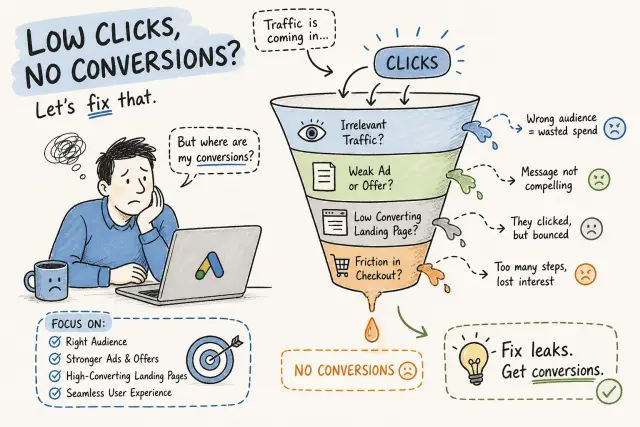
If your Google Ads are not converting, you are not alone, and you are almost certainly not facing a market problem. You set the budget, built the campaigns, and the clicks are coming in. But the sales? Nowhere to be found. If you are watching ad spend drain out every day with little to show for it, the issue is almost always structural. Campaigns with Google Ads not converting well often have a small number of fixable root causes once you know where to look.
At ThinqMedia, managing Google Ads campaigns across e-commerce, SaaS, real estate, and fintech clients in Nigeria and the United States, we see the same failure patterns repeat across industries. The keywords change. The products change. But the root causes of low ROAS on Google Ads stay remarkably consistent: broken tracking, wrong-intent traffic, and landing pages that lose the sale before it begins. This article walks you through a prioritised diagnostic framework to find your top conversion killers and fix them fast.
What low conversions are actually telling you
Before you start making changes, you need to understand what the data is actually pointing to. Clicks with no conversions can mean two fundamentally different things, and the fix for each is completely different. The wrong people could be clicking on your ads, or the right people could be clicking but something is stopping them from completing the action. Diagnosing which one you are dealing with determines where you spend your time.
Is it a traffic problem or a conversion problem?
A traffic problem shows up as high spend, irrelevant search terms, and a click-through audience that was never likely to buy. A conversion problem shows up as relevant traffic hitting the page but bouncing without completing the intended action. The search terms report tells you whether you have the first problem. Your landing-page analytics, including bounce rate, scroll depth, and form abandonment, tell you whether you have the second. Conflating the two leads to expensive guesswork.
What conversion rates should you actually expect?
The 2026 industry average for Google Ads search conversion rates sits around 8% across all categories, though this varies widely by sector. E-commerce and retail campaigns typically convert between 2.7% and 3.6% on search, while categories like healthcare, education, and professional services tend to perform higher. Real estate campaigns, by comparison, average between 2.5% and 3.3%. Nigerian advertisers should treat these global figures as a starting point rather than a fixed target, adjusting for local factors like mobile device mix, payment friction, and logistics considerations, since country-level performance can differ meaningfully from global averages.
Google Ads not converting? Rule out broken tracking first
If your conversion tracking is inaccurate, nothing else in your account matters. You can fix keywords, redesign landing pages, and adjust bids all day, but you will be making decisions based on data that does not reflect reality. Run this diagnostic step before anything else, it typically takes less than ten minutes.
Why your campaign might be "converting" less than it appears
The most common tracking failures are not obvious. The Google Ads conversion tag fires on every page instead of just the confirmation or thank-you page, inflating conversion counts with phantom actions. Or the event trigger is too broad, recording intent signals like button hovers instead of actual submissions. Equally damaging is the inverse: the Conversion Linker is missing from Google Tag Manager, meaning valid conversions go unrecorded and Smart Bidding optimises on incomplete data. Both over-counting and under-counting corrupt your bidding algorithm and mask what is actually happening in the campaign.
A quick verification checklist you can run in 10 minutes
Start with GTM Preview mode or Google Tag Assistant and complete a real test conversion flow from start to finish. Confirm the Google Ads conversion tag fires exactly once on the correct page or event, not on page load globally. Then open Google Ads under Tools, go to Conversions, and check the tracking status for each conversion action, the status should show as Active and recording. Finally, compare the conversion count reported in Google Ads against your CRM or backend order data for the same 30-day period. A discrepancy larger than roughly 10% points to a tagging, deduplication, or consent-mode issue that needs to be resolved before any other optimisation takes place.
How keyword match types are sending the wrong traffic
Keyword intent mismatch is one of the most common and most misunderstood reasons PPC campaigns, what some advertisers still call AdWords campaigns, accumulate spend without generating revenue. It happens quietly, search term by search term, until a meaningful share of your budget is funding clicks from people who were never going to convert.
The intent gap broad match creates
Broad match and overly permissive phrase match allow your ads to appear for queries that look related on the surface but carry completely different intent. A user searching "how to set up Google Ads" and a user searching "hire a Google Ads agency" both touch Google Ads as a topic. Without tight match-type discipline, both queries can trigger the same ad. The first user is researching. The second is ready to act. Serving the same ad to both and paying for both clicks means you are subsidising an audience that will never convert, which tanks your overall Google Ads conversion rate.
Using the search terms report to stop the bleed
Open the search terms report, sort by spend, and filter for queries with zero conversions over the last 30 days. Look for patterns, not just individual terms. Common offenders include job-seekers looking for employment in your category, people hunting for free tools or tutorials, and informational researchers who are months away from any purchase decision. Add those patterns as negative keywords with the correct match type. This review should happen weekly. The search landscape shifts constantly, and new irrelevant queries enter the auction without warning. Monthly reviews are not frequent enough to prevent meaningful budget waste.
Why your landing page is where most conversions die
Even with clean tracking and tight keyword targeting, a weak landing page will kill your conversion rate. The click is a signal of interest. The landing page is where that interest either becomes action or evaporates. Several variables determine which outcome you get.
Headline and message match: the biggest single lever
The headline is the highest-impact element on any paid search landing page. When it mirrors the ad copy and the intent behind the search query that triggered the click, visitors feel immediately confident they are in the right place. When it does not, they leave within seconds, and that exit costs you the click cost and the potential sale. Unbounce's conversion research consistently finds that strong message match between ad and headline can lift conversion rates dramatically, with documented improvements of 250% or more from headline alignment alone. This is where most advertisers lose the sale before it even begins.
Form length, CTA clarity, and load speed
These variables function as multipliers. Shorter forms convert better: three fields consistently outperform five, and every additional field you add reduces the likelihood of completion. A single, focused call to action outperforms pages that present multiple links or competing offers. Load speed matters most on mobile, Google and Deloitte's mobile speed research found that a one-second delay can reduce conversion rate by up to 20%. For Nigerian audiences specifically, mobile performance is non-negotiable: mobile-first browsing is the norm, and variable network conditions make page weight a genuine conversion barrier rather than a marginal concern.
Ad-to-page alignment: does your page deliver the promise?
Message match goes beyond the headline. If your ad promotes a specific discount, the landing page must lead with that discount. If your ad highlights a particular product, the landing page must open on that product, not on your homepage. Misalignment between what the ad promises and what the page delivers is one of the clearest indicators that a campaign was configured once and never revisited. That single oversight is responsible for more wasted spend than most advertisers realise.
The prioritised audit checklist: find your top conversion killers today
A structured audit saves time and prevents the common mistake of optimising the wrong layer of the account. Work through these checks in order. The highest-leverage issues come first, and resolving them often eliminates the need to go deeper.
Tier 1: three checks to run before anything else
Verify that conversion tracking is recording accurately. Use Tag Assistant and the Google Ads Conversions status panel to confirm the tag fires correctly and data matches your backend within 10%. Next, pull the search terms report and identify every query that has generated spend but zero conversions over the last 30 days, add the irrelevant patterns as negatives immediately. Then load your landing page on a mobile device representative of your audience (in many Nigerian markets, this means a mid-range Android handset, though verify this against your own analytics), and assess load speed, headline relevance, and CTA clarity with fresh eyes. These three checks resolve the majority of conversion failures without requiring any changes to bids or creative.
Tier 2: bidding, targeting, and account structure
Once Tier 1 is clean, move to secondary diagnostics. Review whether your bidding strategy has enough conversion data to function correctly. Google recommends at least 30 conversions per month for Smart Bidding algorithms like Target CPA or Target ROAS to optimise effectively; campaigns with fewer conversions often perform erratically. Check geographic targeting for any regions generating meaningful spend but zero conversions, and exclude or bid down accordingly. Finally, audit your campaign structure to confirm that ad groups are tightly themed and that high-intent and low-intent keywords are not competing in the same group, diluting quality scores and relevance.
Why regular, active optimisation is the real antidote
The audit checklist addresses the immediate problems. But the structural reason most campaigns develop conversion failures in the first place is simpler: they were set up and left alone. Google Ads is not a passive channel, and treating it as one is the fastest way to turn a sound campaign structure into a budget drain.
The "set it and forget it" trap and what it costs you
The auction changes constantly. Search query patterns shift with seasons, news cycles, and competitor activity. Landing-page performance drifts as the competitive landscape evolves. Bidding algorithms need continuous human oversight to avoid locking onto wasteful patterns that inflate spend without improving results. Most campaigns with Google Ads not converting well were actually built with sound logic. The problem is not the initial setup; it is the absence of active management after launch.
What active management actually changes
Consistent, hands-on management covers weekly search-term mining and negative keyword hygiene, landing-page performance monitoring, bid-strategy health checks, and creative refresh cycles tied to performance signals. This is the model ThinqMedia runs across managed campaigns: granular data analysis paired with transparent, real-time reporting so clients see exactly where conversions are being won and where budget is leaking. The difference between a campaign that converts profitably and one that haemorrhages spend is rarely the product or the budget. It is the frequency and quality of optimisation applied week after week.
The path forward starts with a clear diagnosis
Poor conversion performance is a diagnosable problem with identifiable causes. The priority order matters: fix tracking first so your data is trustworthy, then address keyword intent and search-term hygiene, then align your landing page to the ad promise, and finally review bidding structure once the foundations are solid. The audit framework in this article gives you the tools to identify your top conversion killers without guesswork.
If your Google Ads are not converting, the problem is unlikely to resolve itself, it requires deliberate, structured attention each week. The campaigns that generate consistent, predictable results are managed actively on a regular cadence. If that level of attention is not feasible with your internal team, reach out to ThinqMedia to discuss a diagnostic audit of your current Google Ads account and find out exactly where your budget is going.
Admin Strategist
Thinq Media Strategy