Your Meta Ads Are Generating Leads. So Why Aren’t You Making Sales?
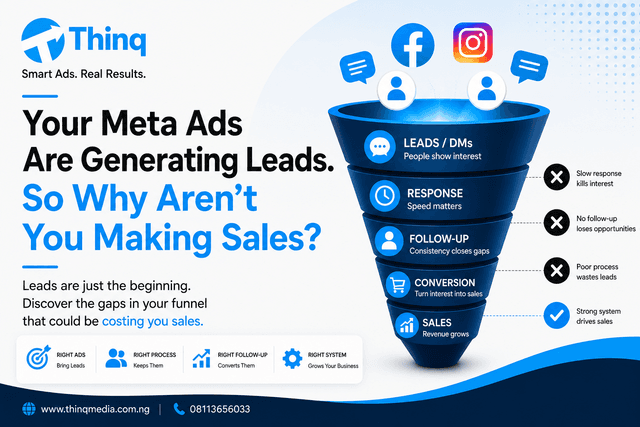
One of the most frustrating things for a business owner is spending money on advertising, seeing leads come in, and still not seeing enough sales.
The immediate reaction is usually:
“The ads aren't working.”
Sometimes that is true.
But sometimes the advertising is doing exactly what it was designed to do. The problem is what happens after the lead comes in.
A Meta Ads campaign can successfully generate DMs, enquiries and leads, but if the business doesn't have the people, processes or follow-up system required to convert those opportunities, the campaign can look like a failure.
And that can lead to a very expensive mistake:
Blaming the advertising for a problem that exists inside the sales process.
A Lead Is Not a Sale
This is the first distinction businesses need to understand.
Someone clicking your ad is not a customer.
Someone sending you a DM is not a customer.
Someone filling out a lead form is not a customer.
These are opportunities to sell.
The journey might look like this:
Ad → Click → Enquiry → Response → Qualification → Follow-up → Consideration → Purchase
There are several points along that journey where a potential customer can disappear.
Imagine your campaign generates 50 enquiries, but your sales team only has the capacity to properly handle 20.
The remaining 30 might receive a late response, a poor response, or no response at all.
Now imagine the business owner looks at the final sales number and says:
“The ads aren't working.”
But did the advertising actually fail?
Or did the business fail to convert the opportunities it generated?
That's the question you need to answer first.
Your Sales Team Is Part of Your Advertising Strategy
This becomes particularly important when your campaign objective is to generate DMs.
If your advertising is designed to start conversations, someone needs to be available to manage those conversations.
This sounds obvious, but many businesses don't plan for it.
They focus on the budget, audience, creative, and campaign objective.
Then the campaign launches and the enquiries start coming in.
Suddenly, the sales team is overwhelmed.
Messages are answered late.
Follow-ups are missed.
Potential customers move on.
Eventually, the business concludes that the leads are poor quality.
Sometimes they are.
But sometimes the business simply didn't have the capacity to manage the demand it created.
Don't generate more leads than your business can reasonably handle.
A lesson I've seen firsthand
In a recent campaign, the advertising was generating a significant number of DMs.
The challenge wasn't getting people to start conversations. The sales team was simply too small to comfortably manage the volume while also following up with existing prospects.
Instead of continuing to increase the advertising budget, we reduced the daily spend to bring the volume down to a level the team could realistically manage.
The objective wasn't to generate the maximum possible number of DMs.
It was to generate a manageable number of quality conversations that the sales team could actually work and convert.
That's an important distinction.
More leads aren't always better if your business isn't equipped to convert them.
A Cheap Lead Can Still Be an Expensive Lead
This is another mistake businesses make when evaluating advertising.
Suppose Campaign A generates leads at ₦2,000 each.
Campaign B generates leads at ₦5,000 each.
At first glance, Campaign A looks better.
But suppose Campaign A generates 100 leads and only 5 become customers, while Campaign B generates 50 leads and 10 become customers.
Which campaign performed better?
You cannot answer that by looking at cost per lead alone.
This is why performance marketing needs to go beyond surface-level metrics.
Cost per lead matters. But what happens after the lead matters more.
You should be looking at qualified leads, sales conversion, customer acquisition cost, and ultimately revenue.
Your Response Time Matters
There's another factor businesses often underestimate:
How quickly do you respond to a new enquiry?
Think about your own behaviour as a customer.
You see a product you're interested in.
You send a message.
Nobody responds.
An hour passes.
Three hours pass.
The next day, someone finally responds.
By then, you may have already contacted another business.
A good advertising campaign can create interest, but the business has to be ready to act on that interest.
You need to know:
Who receives the lead?
Who responds?
How quickly do they respond?
What information do they provide?
How do they qualify the prospect?
When do they follow up?
Without a process, part of your advertising investment is effectively being left to chance.
Follow-Up Is Where Many Sales Are Lost
Not every customer buys during the first conversation.
This is particularly true for products that require consideration.
A potential customer may say:
"I'll get back to you."
That doesn't necessarily mean they've lost interest.
They may need time to compare options.
They may need to speak with someone else.
They may be waiting for funds.
They may simply have become distracted.
That's why follow-up matters.
If someone has shown genuine interest, the sales process shouldn't necessarily end because they didn't buy immediately.
And this is why generating more leads isn't always the answer.
If you're not following up with the leads you already have, why are you spending more money to generate additional ones?
High-Value Products Need a Different Expectation
Now consider a business selling products worth ₦700,000, ₦2 million, ₦5 million, or even ₦7 million.
Should you expect everyone who clicks a Google Search ad or responds to a Meta campaign to buy immediately?
Probably not.
The higher the financial commitment, the more consideration a customer may require.
They may compare suppliers.
They may ask detailed questions.
They may want to inspect the product.
They may discuss the purchase with someone else.
They may need financing.
They may simply need time.
That doesn't automatically mean the advertising isn't working.
It may mean you're dealing with a longer buying cycle.
This is particularly important with Google Search.
Search advertising can put your business in front of people actively looking for a product or service. That's valuable intent.
But search intent isn't the same as an immediate purchase.
Someone can search for a ₦7 million product, click your ad, visit your website, and still decide not to purchase that day.
That doesn't automatically make the campaign a failure.
Don't Judge the Campaign Only by the Final Sale
This doesn't mean you should run a bad campaign indefinitely.
You shouldn't.
If the data shows that something isn't working, you should investigate and optimise.
But there's a difference between optimising based on evidence and declaring a campaign a failure because the final sales number isn't where you expected it to be yet.
A four-week campaign can provide useful data.
But four weeks doesn't automatically tell you everything about a campaign, especially when you're dealing with a high-value product or a longer buying cycle.
Look at what is happening throughout the funnel.
Are people clicking?
Are qualified people engaging?
Are they sending enquiries?
Are they calling?
Are they visiting the website?
Are they asking questions?
Is the sales team responding?
Are prospects being followed up?
Are some prospects still considering the purchase?
More Budget Won't Fix a Broken Funnel
This is where businesses often make another mistake.
The campaign isn't producing enough sales.
So they increase the budget.
But if the underlying problem is poor tracking, slow follow-up, limited sales capacity, a weak landing page or an uncompetitive offer, more money doesn't automatically solve the problem.
It may simply create more leads that the business still cannot convert.
Think about it:
If your sales team cannot properly handle 30 leads, why would you give them 100?
If your website isn't converting qualified visitors, why would you simply send more traffic?
If your product requires significant consideration, why would you expect every click to immediately become a sale?
Scale what works. Don't scale confusion.
What Should You Measure?
Don't stop at cost per lead. Look at the entire customer journey:
Advertising: Reach, impressions, and CPM.
Interest: CTR, clicks, and website visits.
Lead generation: Number of leads and cost per lead.
Lead quality: Number of qualified leads.
Sales response: Number of leads contacted and response time.
Follow-up: Follow-up rate and conversations.
Conversion: Number of customers acquired.
Revenue: Revenue generated.
Efficiency: Customer acquisition cost.
This gives you a much clearer picture of where the problem actually exists.
For example, if your CPL is increasing, investigate it.
But if your CPL is acceptable and qualified leads are increasing while sales remain flat, the problem may be further down the funnel.
That's a very different problem.
Before You Blame Your Ads, Ask These Questions
1. Are we generating the right type of leads?
Not every lead is a good lead.
2. Are we responding quickly enough?
A good lead can become a lost opportunity if nobody responds.
3. Do we have enough people to handle the volume?
Your advertising budget should be aligned with your sales capacity.
4. Are we following up?
Many prospects won't buy after the first interaction.
5. Is our offer competitive?
Advertising cannot make an unattractive offer automatically attractive.
6. Is the buying cycle realistic?
A ₦7 million purchase shouldn't necessarily be evaluated like a ₦20,000 purchase.
7. Are we measuring the entire funnel?
If you're only looking at leads or sales, you may be missing where the real problem is.
8. Are we giving the campaign enough time and data to make a reasonable judgement?
Don't confuse impatience with optimisation.
Final Thoughts
Your advertising campaign doesn't end when someone clicks.
It doesn't end when someone sends a DM.
It doesn't end when someone fills out a form.
The real objective is to move the right person through the journey until they become a customer.
That's why I don't think the first question should always be:
“How many sales did the ads generate?”
The better question is:
“What happened to the people the ads generated?”
Did they receive a response?
Did someone follow up?
Were they qualified?
Did they receive the information they needed?
Was the offer right for them?
Were they ready to buy?
Did the business have the capacity to serve them?
When you answer those questions, you can finally determine whether your advertising is actually the problem.
Because sometimes the campaign isn't failing.
The leads are simply getting lost after the ad does its job.
And if that's what's happening, the solution isn't necessarily to spend more money.
It's to fix the part of the customer journey where you're losing the sale.
Frequently Asked Questions
Why am I getting leads from Meta Ads but no sales?
Your leads may be getting lost after they enter the funnel. Check lead quality, response time, sales capacity, follow-up, pricing, your offer, and the overall customer journey before concluding that the advertising is responsible.
Should I increase my Meta Ads budget if I need more sales?
Not automatically. If your sales team cannot properly handle your current lead volume, increasing your budget may create more leads without increasing sales. Fix the bottleneck first.
How long should I run Meta Ads before deciding whether they work?
There is no universal timeframe. Consider your campaign objective, budget, conversion volume, product and buying cycle. A campaign should be evaluated using sufficient data and the full funnel rather than an arbitrary number of days.
Why are my Google Ads generating clicks but no sales?
Clicks indicate interest or search activity, not guaranteed purchases. For higher-priced products, customers may need more time and information before buying. You should also investigate your landing page, offer, sales response and follow-up process.
What is more important, cost per lead or cost per sale?
Cost per sale is more closely connected to revenue. A low cost per lead can look attractive while producing very few customers. Lead quality and downstream conversion matter.
Can Meta Ads guarantee sales?
No. Advertising can generate awareness, traffic, enquiries, and potential customers, but the final sale depends on many factors beyond the advertising platform.
Admin Strategist
Thinq Media Strategy