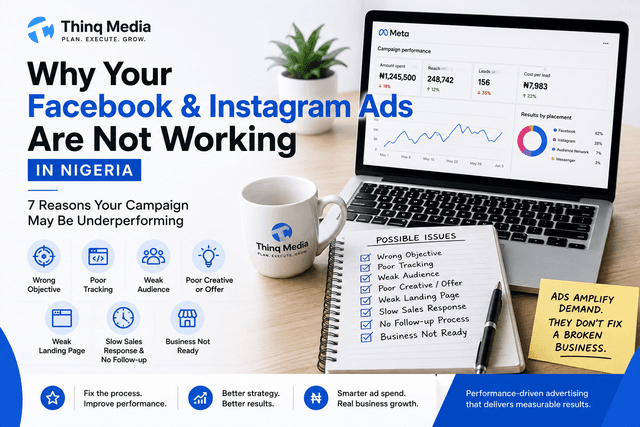
Why Your Facebook & Instagram Ads Are Not Working in Nigeria: 7 Reasons Your Campaign May Be Underperforming
You've launched your Facebook and Instagram Ads.
The campaign is running. People are seeing your ads. Some are clicking. You may even be getting leads.
But the sales aren't coming.
So you increase the budget.
Still nothing.
You change the audience.
Still nothing.
You change the creative.
Still disappointing.
Eventually, you start asking:
"Do Meta Ads actually work?"
The answer is yes, but there is a problem with how many businesses approach paid advertising.
They often treat the advertisement as the entire marketing system.
It isn't.
After managing more than ₦50 million in Meta advertising across industries including finance, insurance, real estate, education, healthcare, hospitality, FMCG, and others, I've learned that poor campaign performance isn't always an advertising problem.
Sometimes the problem is the tracking.
Sometimes it's the campaign objective.
Sometimes it's the creative or offer.
And sometimes, the biggest problem happens after the lead has already been generated.
Here are seven reasons your Facebook and Instagram Ads may be underperforming.
1. You Chose the Wrong Campaign Objective
Before Meta starts delivering your advertisements, you tell the platform what you want to achieve.
That decision matters.
If your objective is to generate leads, but you optimise primarily for traffic, Meta will look for people who are more likely to click.
That can produce impressive traffic numbers without necessarily producing qualified enquiries.
The same principle applies to awareness, engagement, messages, app promotion and sales campaigns.
The cheapest result isn't necessarily the most valuable result.
For example, a campaign can generate thousands of inexpensive clicks but very few customers.
Another campaign may generate fewer clicks at a higher cost but produce significantly more qualified leads or sales.
The question therefore shouldn't be:
"Which objective gives me the cheapest result?"
It should be:
"Which objective is most closely aligned with the business outcome I want?"
Your campaign objective should be determined by the result you ultimately want from the customer.
2. Your Tracking Is Broken or Incomplete
This is one of the easiest ways to make a good campaign look bad.
Imagine your website receives 100 completed enquiries, but your tracking system records only 30.
From Meta's perspective, the campaign may appear to be generating very few conversions.
You might then pause the campaign or change your strategy when the real problem is that your conversion data isn't being captured correctly.
Depending on the campaign, your tracking setup may involve tools such as:
Meta Pixel
Conversion API
Google Analytics 4
Google Tag Manager
Proper conversion events
UTM parameters
CRM or lead tracking
Before spending heavily on advertising, make sure you can answer a simple question:
"What happens after someone clicks my ad, and can I accurately measure it?"
If you can't answer that, increasing your budget is premature.
3. Your Audience Strategy Isn't Giving Meta Enough Direction
Meta's advertising system has become increasingly automated, particularly with AI-powered features such as Advantage+ Audience.
That doesn't mean advertisers no longer need an audience strategy.
It means the role of the advertiser has changed.
Instead of trying to manually identify every single person who should see an advertisement, you need to give Meta strong signals and allow its systems to find people who are more likely to take the desired action.
That starts with understanding your customer.
Who are they?
What problem are they trying to solve?
What makes them likely to buy?
What locations matter?
What customer data can you provide?
What previous conversion data does Meta have?
For example, a real estate company and a fashion retailer may both advertise on Instagram, but their customers have completely different buying behaviours.
The goal isn't necessarily to create the most complicated audience.
The goal is to give Meta enough useful information to find the right people.
4. Your Creative or Offer Isn't Strong Enough
You can have the right objective, tracking, and audience strategy and still struggle because people simply don't care about the advertisement.
People don't open Facebook or Instagram because they want to see your advert.
You're competing with entertainment, conversations, news, creators, and hundreds of other pieces of content.
Your creative needs to earn attention.
A strong creative can improve engagement, click-through rates, and overall campaign efficiency.
A weak creative can do the opposite.
But creative isn't only about making something visually attractive.
Your offer matters too.
Consider the difference between:
"We provide quality real estate services."
and an advertisement that clearly communicates what the customer gets, who the service is for, and why they should take action.
The first tells people what you do.
The second gives them a reason to care.
This is why I recommend testing different creative concepts rather than assuming the first advertisement you create will be your best performer.
Test different:
Hooks
Images and videos
Headlines
Primary text
Calls to action
Offers
Meta's increasingly AI-driven creative tools can also help advertisers evaluate creative variations and identify potential performance opportunities.
But technology doesn't replace good marketing thinking.
You still need to understand why a particular creative is working.
5. Your Landing Page Is Losing the Customer
Getting someone to click your advertisement is only the beginning.
What happens after the click can determine whether that advertising spend eventually produces business.
I've seen campaigns generate significant numbers of clicks without generating a comparable number of enquiries or sign-ups.
When this happens, don't automatically blame Meta.
Look at the landing page.
Ask yourself:
Does the page load quickly?
Is it easy to use on mobile?
Does the headline match the advertisement?
Is the offer immediately clear?
Is the call to action obvious?
Does the page build enough trust?
Are testimonials or reviews available?
Is the form unnecessarily complicated?
Your advertisement makes a promise.
Your landing page needs to continue that promise.
If someone clicks an advert promising one thing and lands on a page that creates confusion, you've already lost part of the opportunity you paid to create.
6. Your Sales Team Is Too Slow, or There Is No Follow-Up
This is one of the biggest problems I see with lead generation campaigns.
The advertisement generates the lead.
Then nothing happens.
A potential customer sends a message at 2:00 p.m., but the sales team responds hours later.
Sometimes the response comes the following day.
By then, the customer may already have contacted a competitor.
This is especially damaging for industries where customers are actively comparing different businesses, such as real estate, insurance, finance, and hospitality.
You can have a perfectly good campaign and still lose money because the business isn't responding to the demand the advertising is generating.
That's why marketing and sales cannot operate as completely separate functions.
Before launching a lead generation campaign, businesses should establish:
Who receives the leads?
How quickly should they respond?
Who follows up?
How many follow-ups should happen?
How are qualified leads identified?
How is sales information reported back to the marketing team?
A lead is not a sale.
Lead generation is the beginning of the sales process, not the end of the marketing process.
7. Your Business Isn't Ready to Convert the Demand
This is perhaps the most expensive mistake of all.
I've seen businesses invest money in advertising when the underlying business wasn't ready.
The product wasn't available.
There were no reviews.
There were no testimonials.
The website wasn't convincing.
The sales team wasn't prepared.
The follow-up process didn't exist.
In some cases, the business simply wasn't ready to fulfil the demand it was asking the advertising campaign to generate.
This creates a dangerous situation.
You can successfully generate attention and enquiries while still losing money.
One of the biggest wastes of advertising money isn't running a bad advert.
It's successfully generating demand for a business that isn't ready to convert it.
Before launching your next campaign, ask:
"If this campaign works extremely well tomorrow, can my business handle the customers it generates?"
If the answer is no, your priority shouldn't be increasing the ad budget.
It should be fixing the business.
Why Spending More Doesn't Always Fix the Problem
This is where many businesses get stuck.
They assume:
More budget = more results.
It doesn't work that way.
I've seen businesses spend over ₦2 million on advertising and achieve disappointing results, while smaller campaigns have performed much more efficiently.
The difference isn't always the amount spent.
It's what happens to the money.
A business with a ₦2 million budget can still have:
Poor tracking
The wrong campaign objective
Weak creative
An unclear offer
Poor targeting signals
A weak landing page
Slow lead response
No follow-up
Increasing the budget doesn't automatically solve any of these problems.
It can simply make the problem more expensive.
That's why I believe businesses should fix the system before aggressively scaling the budget.
What Should You Check Before Increasing Your Meta Ads Budget?
Before putting more money into an underperforming campaign, work through these questions:
1. Objective: Are we optimising for the action that actually matters?
2. Tracking: Are conversions being recorded accurately?
3. Audience: Are we giving Meta strong signals about our potential customers?
4. Creative: Are people actually responding to our advertisements?
5. Offer: Is there a compelling reason for someone to take action?
6. Landing page: Does the experience after the click support conversion?
7. Sales: Are leads being contacted quickly?
8. Follow-up: What happens when someone doesn't buy immediately?
9. Product: Is the business actually ready to fulfil demand?
Only after you've examined these areas should you decide whether increasing the budget is the right move.
A Simple Way to Think About Meta Ads Performance
Your advertising campaign is only one part of the customer journey.
Think of the process as:
Creative → Ad → Click → Landing Page → Lead → Sales Response → Follow-Up → Purchase
If the advertisement is performing well but the landing page is weak, you have a problem.
If the landing page is good but the sales team responds too slowly, you have a problem.
If the sales team responds quickly but the product isn't available, you have a problem.
This is why performance marketing requires more than simply knowing how to set up a campaign in Meta Ads Manager.
You need to understand the entire journey.
What About Meta Ads Benchmarks in Nigeria?
If you've read our previous articles, you'll notice that we provide estimated CPM, CPC, and CPL ranges for different campaign types and industries.
These figures are planning benchmarks, not fixed prices.
Meta advertising costs change based on competition, campaign objective, audience, placements, creative performance, seasonality, and other factors.
For Nigerian advertisers, exchange rate movements can also affect the naira cost of campaigns planned around dollar-denominated media costs.
For example, a media plan created when the exchange rate is ₦1,500 to $1 may need to be adjusted if the exchange rate moves to ₦1,600 to $1 before the campaign begins.
This is why our benchmarks should be used to inform planning, not treated as guaranteed costs.
You can read our previous guide on [How Much Does It Cost to Advertise on Facebook & Instagram in Nigeria?] and our follow-up guide on [How Much Should You Budget for Facebook & Instagram Ads in Nigeria?] to understand the cost and budgeting side in more detail.
Final Thoughts
If your Facebook or Instagram Ads aren't producing the results you expected, don't immediately conclude that Meta Ads don't work.
Find the bottleneck first.
It could be your campaign objective.
It could be tracking.
It could be your creative.
It could be your offer.
It could be your landing page.
It could be your sales team.
Or it could be that your business simply isn't ready to convert the demand your advertising is generating.
The solution isn't always to spend more.
Sometimes, the smartest thing you can do is fix the system before putting more money into it.
At Thinq Media, we believe performance marketing should go beyond generating impressive dashboard metrics. The goal is to connect advertising spend to measurable business outcomes.
Because ultimately:
Ads amplify demand. They don't fix a broken business.
Frequently Asked Questions
Why are my Facebook Ads not generating sales?
Several factors can cause this, including the wrong campaign objective, weak creative, poor tracking, an ineffective offer, a weak landing page, poor lead quality or slow sales follow-up.
Why are my Meta Ads getting clicks but no customers?
Clicks only show that people interacted with your advertisement. They don't guarantee conversion. Check what happens after the click, particularly your landing page, offer, tracking and sales process.
Should I increase my Meta Ads budget if my campaign is performing poorly?
Not immediately. First, identify what is causing the poor performance. Increasing the budget can sometimes make an existing problem more expensive.
How long should I run a Meta Ads campaign before making changes?
There is no universal timeframe. It depends on your campaign objective, budget, conversion volume, and other conditions. Give the campaign enough time and data to make an informed decision rather than making major changes based on very limited results.
Is a low cost per lead always a good thing?
No. A low CPL is useful only if the leads have reasonable commercial value. Ten highly qualified leads can be more valuable than 100 cheap leads that never convert.
Related Articles
How Much Does It Cost to Advertise on Facebook & Instagram in Nigeria?
Understand the factors that influence Meta advertising costs and the benchmark ranges we've observed across campaigns in Nigeria.
How Much Should You Budget for Facebook & Instagram Ads in Nigeria?
Learn how to determine a realistic advertising budget based on your business goals and campaign objectives.
How to Manage Meta Ads Payments Without Billing Problems
Learn how Meta's billing, payment thresholds, invoices, and account spending limits work for businesses advertising in Nigeria.
Admin Strategist
Thinq Media Strategy